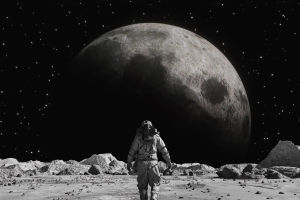
Walking on the Moon is far more challenging than it appears. Astronauts must operate in low gravity, extreme temperatures, and a harsh environment filled with abrasive lunar dust.
To make future missions safer and more effective, space agencies are developing advanced spacesuits, landing systems, habitat technology, and surface equipment.
More than five decades have passed since humans last walked on the Moon in 1972. During that time, technology has improved dramatically, but returning astronauts to the lunar surface remains one of the most demanding engineering projects of the modern era. Future missions are expected to focus on the lunar south pole, a region that offers important scientific opportunities and possible water-ice resources.
Advanced Spacesuits
Modern lunar spacesuits are being designed to provide greater mobility, comfort, and protection than earlier generations. Engineers are improving flexibility in the arms, legs, and gloves so astronauts can handle tools and perform scientific tasks more easily.
The suits must also protect against radiation, extreme temperatures, and tiny high-speed particles in space. Reinforced boots are being developed to improve grip and stability on the dusty lunar surface.
Precision Lunar Landings
Landing near the lunar south pole is especially difficult because the terrain contains craters, steep slopes, and areas with limited sunlight. To reduce risk, autonomous landing systems are being developed that use cameras, lasers, and onboard computers to detect hazards and guide the spacecraft to a safer landing site.
These technologies are intended to increase accuracy and improve safety during the final descent to the surface.
Managing Lunar Dust
Lunar dust is one of the most serious operational challenges. The particles are extremely fine, sharp, and tend to cling to equipment and spacesuits because of electrostatic effects.
Researchers are testing dust-removal systems that use electrical forces to move particles away from visors, sensors, and other critical surfaces. New materials that resist dust buildup are also being evaluated for future missions.
Living and Working on the Moon
Future lunar missions require reliable life-support systems. Habitat modules must provide clean air, stable temperatures, and safe waste-management systems for astronauts during their stay on the surface.
Engineers are developing compact technologies that can support several days of lunar operations while minimizing maintenance and conserving resources.
Mission Profile
A typical future lunar mission is expected to carry a crew into lunar orbit, where a smaller group would descend to the surface. The journey from Earth to the Moon takes about three days.
Astronauts are expected to spend roughly one week conducting scientific experiments, collecting samples, testing new technologies, and exploring the surrounding terrain. The complete mission, including travel and orbital operations, would last about one month.
International Cooperation
Lunar exploration has become a cooperative effort involving multiple space agencies. Different partners are contributing spacecraft systems, power and propulsion technology, robotics, communications, and surface mobility solutions.
This collaboration allows expertise and resources to be shared while supporting the long-term development of deep-space exploration capabilities.
Training for the Moon
Astronauts undergo extensive training before a lunar mission. Simulations take place in deserts, underwater facilities, and specialized research centers that help recreate aspects of reduced gravity and challenging surface operations.
They practice driving rovers, repairing equipment, drilling into the surface, and performing scientific tasks while wearing heavy protective suits.
The Bigger Goal
The Moon is more than a destination. It serves as a testing ground for future missions deeper into space. Technologies developed for lunar exploration—such as dust protection, advanced life support, surface power systems, and resource utilization—may help support future human missions beyond the Moon.
Water ice near the lunar south pole is of particular interest because it could potentially provide water, oxygen, and fuel for future exploration.
The next human steps on the Moon will be supported by decades of scientific research and engineering progress. Every element of the mission—from spacesuits and landing systems to habitats and dust protection—is being designed to improve safety, reliability, and long-term exploration capability.
A return to the lunar surface will represent not only a major technological achievement, but also an important step toward humanity’s future in deep space.