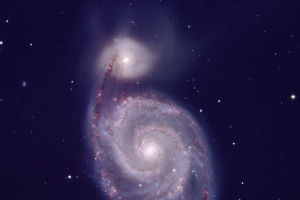
The universe might seem like a fixed stage, with galaxies scattered across an enormous, unchanging space. But astronomers have discovered something remarkable: on the largest scales, the distances between galaxies are increasing as the universe expands.
This does not mean every galaxy is moving away from us. Nearby galaxies can approach one another due to gravitational interactions. Yet across vast cosmic distances, a clear pattern emerges: the farther away a galaxy is, the faster its distance from us generally increases. That relationship helped transform our understanding of the universe.
The Clue Hidden in Starlight
Light contains information about the objects that produce it. When astronomers pass light through a spectrograph, they can identify characteristic patterns of bright or dark spectral lines associated with particular elements. These patterns provide a way to measure how light wavelengths have changed.
In the 1910s, astronomer Vesto Slipher at Lowell Observatory began studying the spectra of objects then called spiral nebulae. He discovered that many showed spectral lines shifted toward longer, redder wavelengths, indicating large apparent recession speeds.
At the time, astronomers had not yet established that these spiral nebulae were separate galaxies beyond the Milky Way. Slipher's measurements nevertheless provided crucial evidence that many of these objects were behaving differently from nearby stars.
For relatively nearby objects, redshift can be interpreted largely in terms of the Doppler effect, which changes the observed wavelength when a source moves relative to an observer. For distant galaxies, however, cosmological redshift is better understood as the expansion of the universe stretching the wavelengths of light as it travels through expanding space.
Slipher did not independently establish the modern picture of cosmic expansion, but his observations became essential to the discoveries that followed. They gave later astronomers a way to connect the properties of distant galaxies to their motions and distances.
Hubble's Surprising Graph
A major breakthrough came when astronomers learned how to measure distances to galaxies beyond the Milky Way. Edwin Hubble used observations made with the 100-inch Telescope at Mount Wilson Observatory to study Cepheid variable stars, whose pulsation periods are related to their intrinsic luminosities.
This relationship had been established through the work of astronomer Henrietta Swan Leavitt. By comparing a Cepheid's expected luminosity with its apparent brightness, astronomers could estimate its distance. Hubble's observations helped demonstrate that some spiral nebulae were actually galaxies far beyond our own.
In 1929, Hubble published evidence of a relationship between galaxy distances and their apparent recession speeds, drawing on redshift measurements from Slipher and other observers. The general pattern was striking: more distant galaxies tended to have greater redshifts.
Belgian physicist and astronomer Georges Lemaître had already derived an expanding-universe model and estimated the relationship between distance and recession speed in 1927. Today, the connection is commonly called the Hubble-Lemaître law, recognizing the contributions of both scientists.
Hubble's original estimate of the expansion rate was approximately 500 kilometers per second per megaparsec, much higher than modern values. Improved distance measurements later corrected that figure.
Today, estimates of the Hubble constant generally range from 67 to 74 kilometers per second per megaparsec, depending on the measurement method. The disagreement between major methods, known as the Hubble tension, remains an important problem in cosmology.
The basic relationship between distance and cosmic expansion remains well established, even though astronomers are still working to determine its precise present-day rate.
Einstein's Missed Opportunity
Albert Einstein's general theory of relativity provided the mathematical foundation for modern cosmology. When applied to the universe as a whole, its equations allow space to change over time rather than remain permanently static.
Einstein initially favored a static universe. In 1917, he introduced a cosmological constant into his equations, allowing a particular model in which gravity could be balanced to maintain an unchanging cosmic scale.
Other scientists soon explored different possibilities. Alexander Friedmann showed in the early 1920s that Einstein's equations permitted expanding or contracting universes. Georges Lemaître later connected expanding-universe solutions with astronomical observations.
As evidence for cosmic expansion accumulated, Einstein moved away from his original static model. He is often said to have called the introduction of the cosmological constant his greatest blunder, but the historical evidence for that exact remark is uncertain.
The cosmological constant itself was not necessarily a mistake. In modern cosmology, it remains the simplest mathematical description of dark energy, the component of the standard model used to explain the universe's accelerated expansion.
Einstein's equations therefore proved more flexible than his original cosmological interpretation. They helped establish the framework through which astronomers now study the universe's changing size and evolution.
Why It Still Expands Today
The universe has been expanding for approximately 13.8 billion years, but this expansion should not be pictured as an explosion sending galaxies outward from one central location. The Big B. model describes an early hot, dense state from which the universe evolved, with distances between widely separated regions increasing as space expands.
The expansion rate has changed over cosmic history. For billions of years, the gravitational attraction of matter slowed the expansion. However, observations eventually revealed that the universe's expansion later began accelerating.
In the late 1990s, two independent research teams studied distant Type Ia supernovae, stellar explosions whose luminosities can be standardized to estimate distances. They found that the supernovae appeared dimmer than expected in a universe whose expansion was simply slowing under gravity.
Combined with other observations, these results provided strong evidence that cosmic expansion is accelerating. The leading explanation is dark energy, a poorly understood component that accounts for roughly 68 to 70 percent of the universe's total energy density in the standard cosmological model.
Dark energy is often described as a repulsive influence, but that description can be misleading. In general relativity, a cosmological constant affects how the expansion of the universe evolves through its energy density and negative pressure. It does not behave like an ordinary force pushing individual galaxies apart.
Researchers are still investigating whether dark energy is truly constant. Results from the Dark Energy Spectroscopic Instrument, or DESI, have strengthened hints that its properties might change over time, although the evidence is not yet conclusive and depends partly on how different observations are combined.
The universe's continued expansion is well supported by measurements. Exactly what governs its long-term behavior, however, remains one of cosmology's major unanswered questions.
Cosmic expansion changes how astronomers understand both distance and time. Light from a distant galaxy may have traveled for billions of years, while the space separating that galaxy from us continued to expand along the way. This helps explain why the observable universe is estimated to be about 92 to 93 billion light-years across, even though the universe is approximately 13.8 billion years old.
From Slipher's early redshift measurements to modern studies of supernovae and dark energy, astronomers have built a detailed picture of a universe that changes over time. The expansion itself is firmly established, but its precise rate and ultimate future remain subjects of active research.