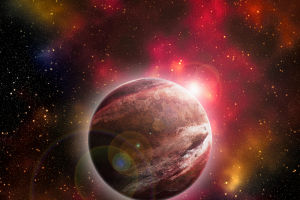
Most planets beyond our solar system are too faint and too close to their host stars in the sky to photograph directly. Instead, astronomers often discover them through subtle changes in starlight or their gravitational effects on nearby objects.
These observations can reveal a planet's size, mass, and orbit, but no single technique provides all the answers. By combining different measurements, scientists gradually build a clearer picture of distant worlds and their possible compositions.
How a Dip in Starlight Reveals Size
One of the most successful methods for discovering exoplanets is the transit method. When a planet passes in front of its host star from our viewpoint, it blocks a small fraction of the star's light, producing a temporary decrease in brightness.
For a simple transit, the fraction of light blocked is approximately equal to the square of the planet's radius divided by the star's radius. If a star dims by 1%, the planet's radius is approximately one-tenth of the star's radius, assuming effects such as limb darkening are accounted for.
Astronomers therefore need to know the star's size before they can calculate the planet's actual radius. Uncertainties in stellar measurements also affect estimates of planetary size.
NASA's Kepler space telescope used this technique to monitor more than 150,000 stars during its original mission, discovering thousands of planet candidates and helping transform our understanding of planetary systems.
However, a transit alone generally cannot determine a planet's mass. It tells astronomers how much light the planet blocks, not how much matter it contains.
Measuring Mass Through a Star's Wobble
A planet does not orbit a completely stationary star. Both objects move around their shared center of mass, causing the star to undergo a small gravitational wobble.
Astronomers can detect part of this movement using the radial velocity method. As the star moves toward or away from Earth, its spectral lines shift slightly because of the Doppler effect.
By measuring these shifts over time, scientists can estimate the gravitational influence of an orbiting planet. Larger planets generally produce stronger signals, although orbital distance, stellar mass, and other factors also affect the measurement.
The famous exoplanet 51 Pegasi b, discovered in 1995, was detected through radial velocity observations. Its discovery demonstrated that a giant planet could orbit remarkably close to a Sun-like star.
Radial velocity measurements usually yield a lower limit on planetary mass because the orbital inclination may be unknown. When a planet also transits its star, astronomers can constrain the inclination and obtain a more accurate estimate of its actual mass.
How Timing Helps Reveal an Orbit
Repeated transits allow astronomers to measure a planet's orbital period, which is the time it takes to complete one revolution around its star.
By measuring the interval between successive transits, scientists can determine the length of the planet's year. Combined with information about the host star, the period can also help estimate the planet's orbital distance using Kepler's laws.
However, a complete description of an orbit requires additional information, including its shape and orientation. Astronomers may use transit duration, radial velocity measurements, and other observations to investigate these properties.
Some planetary systems reveal even more through small changes in transit timing. When multiple planets orbit the same star, their gravitational interactions can cause transits to occur slightly earlier or later than expected.
These transit timing variations can help researchers estimate planetary masses and orbital properties, especially when the planets are difficult to study through radial velocities.
Kepler-16b, a planet orbiting two stars, also demonstrated how detailed timing measurements and the motions of multiple objects can reveal an unusual planetary system.
Combining Mass and Size to Calculate Density
When astronomers know a planet's mass and radius, they can calculate its average density. This measurement provides important clues about the materials that may make up the planet.
Rocky planets generally have relatively high average densities. Earth, for example, has an average density of about 5.5 grams per cubic centimeter, reflecting its combination of rocky material and a dense metallic core.
Gas-rich planets can have much lower average densities. Jupiter's average density is approximately 1.3 grams per cubic centimeter, despite its enormous mass.
However, density alone cannot reveal a planet's exact composition. A relatively low-density world might contain a substantial gas envelope, large amounts of water-rich material, or some combination of different components.
Kepler-10b was among the first exoplanets whose measured mass and radius provided strong evidence for a predominantly rocky composition.
By comparing measurements with planetary interior models, astronomers can investigate possible structures, but different compositions may still fit the same observations.
Why Exoplanet Measurements Remain Difficult
Measuring distant planets requires extraordinary precision. Stellar activity, including starspots, magnetic variations, and surface oscillations, can interfere with the small signals astronomers are trying to detect.
These effects can complicate radial velocity measurements and sometimes resemble the periodic changes caused by orbiting planets.
Large planets orbiting close to their stars are often easier to detect because they produce stronger gravitational signals and, when they transit, more noticeable changes in brightness.
Small planets with long orbital periods are generally more challenging to detect. Their transits may be shallow and infrequent, while the gravitational motion they induce in their stars can be extremely subtle.
Astronomers address these difficulties by collecting repeated observations, comparing different techniques, and carefully modeling sources of uncertainty.
When the available evidence is insufficient, researchers may report a range of possible masses or an upper limit rather than a precise value.
These uncertainties are an essential part of the scientific process, allowing future observations to improve estimates as instruments and methods become more sensitive.
Measuring an exoplanet is a careful process of combining small clues from distant starlight. Transits help reveal planetary size, radial velocity observations can estimate mass, and repeated measurements provide information about orbital motion. When mass and radius are both known, astronomers can calculate density and investigate what the planet might be made of. Although uncertainties remain, these techniques have allowed scientists to characterize worlds far beyond our solar system.