Picture trying to map a city you've never left.
That's roughly the challenge astronomers face when studying the Milky Way. We're inside it, positioned about a third of the way from the center to the outer edge, sitting in the flat disk about 95 light-years from the central plane.
Getting a clear picture of the full structure from here is genuinely difficult — the galaxy's own gas and dust block our view in many directions.
What Kind of Galaxy Is It?
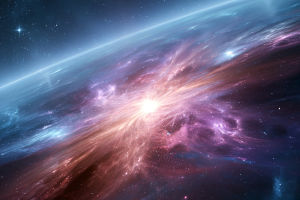
The Milky Way is a barred spiral galaxy. That means it has a flat rotating disk of stars and gas, spiral arms extending outward, and a central bar-shaped structure of older stars running through its middle.
The disk stretches roughly 100,000 light-years across and is only about 1,000 light-years thick at the spiral arms — incredibly flat relative to its width. At the center sits a dense bulge about 10,000 light-years in diameter, glowing yellowish-red because it's packed with older red giant stars. Active star formation isn't really happening there. That action happens in the spiral arms, where gas, dust, and young hot blue stars concentrate.
The Central Supermassive Black Hole
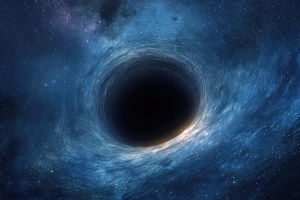
Deep within the bulge lies a supermassive black hole — a region called Sagittarius A* (pronounced "A-star"). The black hole itself can't be observed directly; it emits no light, and layers of gas and dust between us and the galactic center further obscure it. But astronomers can measure the motion of the stars orbiting the area, and those orbital speeds are extraordinary.
The estimates put the mass of Sagittarius A* at a minimum of 3.7 million times the mass of our Sun, compressed into a region at most 45 AU across — roughly the distance from the Sun to Pluto.
Spiral Arms and Star Formation
The spiral arms aren't physical objects so much as patterns — regions of higher density in the rotating disk. They may work like density waves, similar to ripples spreading outward when a stone hits water. Gas and dust slow down as they pass through these denser regions, compressing together and triggering new star formation.
That's why the arms appear to glow blue: they're full of newly born, short-lived, hot blue stars. Clouds passing through a spiral arm can also get compressed by that gravitational nudge, sparking another round of stellar births.
The Dark Matter Problem
Here's one of the galaxy's deepest puzzles. If all of the Milky Way's mass were concentrated in visible stars and gas at the center, outer stars should orbit more slowly — the same way Neptune orbits far more slowly than Mercury. But they don't. Stars near the outer edge of the galaxy orbit at nearly the same speed as those much closer to the center.
To produce that pattern, there must be far more mass spread throughout the galaxy than what we can actually see. Astronomers call this invisible material dark matter. It's estimated to account for about 90% of the Milky Way's total mass. It doesn't emit or reflect any light, hasn't been directly detected yet, and its exact nature remains unknown — one of the biggest open questions in modern physics.
The Milky Way's Neighborhood
The Milky Way isn't isolated. It's the second-largest member of a cluster of over 30 galaxies called the Local Group, trailing only the Andromeda Galaxy. The Local Group in turn is part of the Virgo Supercluster, which contains over 100 galaxies spanning more than 100 million light-years.
And all of it is in motion — the Local Group is traveling toward a massive gravitational concentration called the Great Attractor, moving at roughly 600 km per second through a universe that's simultaneously expanding in all directions.
The Milky Way is home to hundreds of billions of stars, a four-million-solar-mass black hole, and enough dark matter to outweigh everything visible by nine times. We know its shape, its center, and its neighbors. But the dark matter puzzle and the Great Attractor's identity remain open – waiting for answers.